
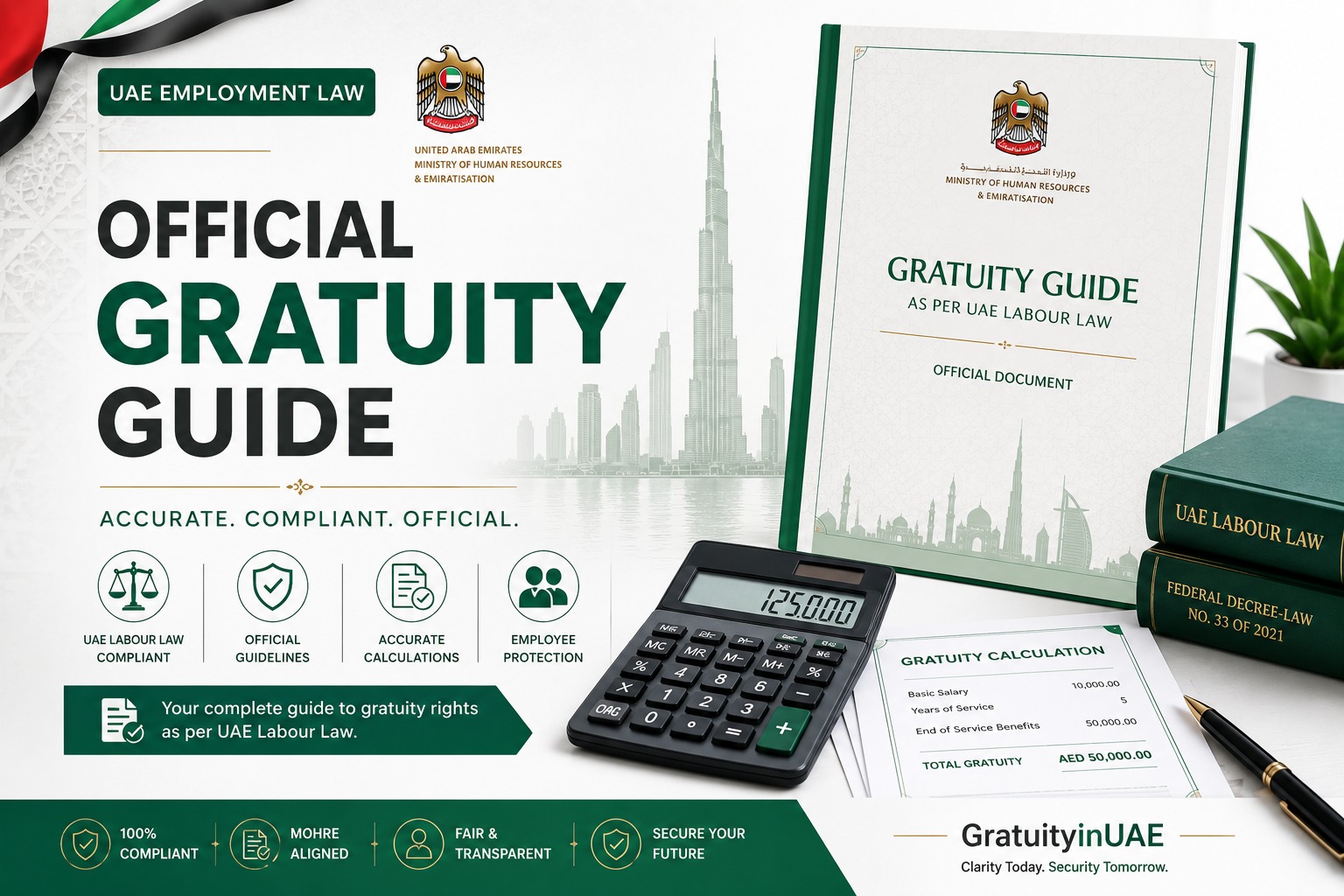
Understanding End of Service Benefits in the UAE
The concept of end of service benefits is crucial for expatriates working in the United Arab Emirates. These benefits, commonly referred to as gratuity in UAE, serve as a form of financial entitlement that employees receive upon the termination of their employment. Understanding how gratuity is calculated can significantly assist expatriates in planning their finances and knowing what to expect when their employment comes to an end.
Need to calculate gratuity? Use our free calculator
The gratuity formula in UAE varies depending on several factors including the duration of employment and the nature of contract termination. Generally, employees are entitled to gratuity calculations based on their final salary and the length of time they have served with the employer. For those who have completed more than one year of service, a specific formula is applied, which involves multiplying the employee’s wage by the number of years worked, thereby enforcing the importance of being familiar with the gratuity calculation guide.
Moreover, expatriates should be knowledgeable about the labor laws governing gratuity in the UAE. The UAE Labor Law stipulates the regulations regarding end of service benefits, providing a legal framework that protects both employees and employers. Knowing these regulations ensures that employees can claim their rightful gratuity without any discrepancies. By utilizing resources such as the UAE gratuity calculator, expatriates can ascertain their expected entitlements, thus fostering informed decision-making at the end of their employment tenure.
Ultimately, understanding the end of service benefits is not only about knowing the financial rewards but also entails grasping the legal rights that come with employment in the UAE. This knowledge empowers expatriates to secure the benefits they deserve and encourages proper financial planning for their transition.
The Core Gratuity Calculation Formula
The gratuity calculation in the UAE is fundamentally governed by a specific formula that considers the duration of employment and the employee’s monthly salary. The basic framework for calculating gratuity is differentiated based on whether the employee has completed more than or less than five years of service.
For employees who complete less than five years of service, the gratuity is calculated at a rate of 21 days of basic salary for each year of service. Conversely, for those who serve more than five years, the gratuity increases to a rate of 30 days of basic salary for each subsequent year, while the initial five years are still calculated at 21 days. This structured approach aims to reward longer tenures with a more substantial gratuity amount.
To perform a gratuity calculation in the UAE accurately, one can utilize the following formula:
Gratuity = (Basic Salary / 30) x Days per Year x Years of Service
For example, if an employee’s basic salary is 10,000 AED and they have worked for six years, the calculation would proceed as follows: For the first five years, the gratuity would be calculated at 21 days, which totals 7,000 AED (10,000 AED / 30 x 21 x 5). For the sixth year, the calculation would be at 30 days, totaling 10,000 AED (10,000 AED / 30 x 30 x 1). Thus, the total gratuity would sum up to 17,000 AED.
This comprehensive gratuity calculation guide ensures that employees are adequately compensated for their service, reflecting the varying rates based on their length of employment. Understanding the gratuity formula UAE is essential for both employers and employees to facilitate accurate remuneration upon termination of services.
Important Factors Influencing Gratuity Calculation
The gratuity calculation in the UAE is influenced by several critical factors, each of which plays a significant role in determining the final gratuity amount owed to an employee upon termination of their contract. A primary aspect to consider is the distinction between basic salary and total salary. The gratuity is generally calculated based on the basic salary mentioned in the employment contract, rather than the overall remuneration package which may include allowances and bonuses. Therefore, it is imperative for both employers and employees to ascertain the correct basic salary figure, as this will have a direct impact on the gratuity calculation.
Additionally, the total duration of service is another vital element that affects gratuity calculations. Employees ought to ensure that their entire period of service is accurately computed, as this duration determines the gratuity entitlement. In the case of resignation, the service duration is divided into different blocks which can impact the gratuity amount. For instance, employees who complete more than five years of continuous service are entitled to a higher gratuity rate compared to those with less than five years.
An important consideration is the treatment of unpaid leave in computing service duration. Unpaid leave can affect the total length of service and, consequently, the gratuity amount. Employers and employees must be mindful of this when accounting for their respective durations of employment, making sure to maintain accurate records of any unpaid leave periods. This ensures that the gratuity calculation adheres to the established gratuity formula in the UAE, facilitating a fair and transparent assessment of an employee’s entitlement to gratuity.
Legal Protections and Gratuity Payout Processes
The legal framework governing gratuity payments in the UAE ensures that employees receive their entitled end-of-service benefits upon termination of their employment. According to UAE labor law, employers are mandated to pay the full gratuity amount within 14 days of the termination date. This provision protects employees from any undue delay in receiving their hard-earned gratuity, which is calculated based on the gratuity formula UAE companies must adhere to.
If an employer fails to meet this obligation, employees have the right to take specific actions to claim their gratuity in UAE. Initially, it is advisable to communicate directly with the employer to resolve the issue amicably. However, if the delay persists, the employee can escalate the matter by filing a complaint with the Ministry of Human Resources and Emiratisation (MoHRE). The MoHRE plays a critical role in ensuring that the rights of workers are upheld and offers a structured process for lodging complaints against employers.
In filing a complaint, employees should prepare relevant documentation, including proof of employment, termination letters, and any correspondence with their employer. It is also beneficial to have details of the gratuity calculation guide at hand, as this will substantiate the claim regarding the owed amount. Once a complaint is filed, the MoHRE will investigate the matter and work towards a resolution. Employers found in violation of the gratuity payout laws can face penalties, thus encouraging timely payments.
Staying updated on the current legal protections and processes related to gratuity is essential for both employees and employers alike. Resources such as MoHRE’s official website provide ongoing updates, ensuring that all stakeholders understand their rights and obligations concerning gratuity payments.
Note: This guide is for general informational purposes. Please read our disclaimer for details on how to use this information responsibly.
If you work for a company registered in a free zone like DMCC or JAFZA, the calculation can differ slightly — see our dedicated free zone gratuity guide.
Not sure what counts as basic salary for this calculation? See our guide to UAE basic salary.