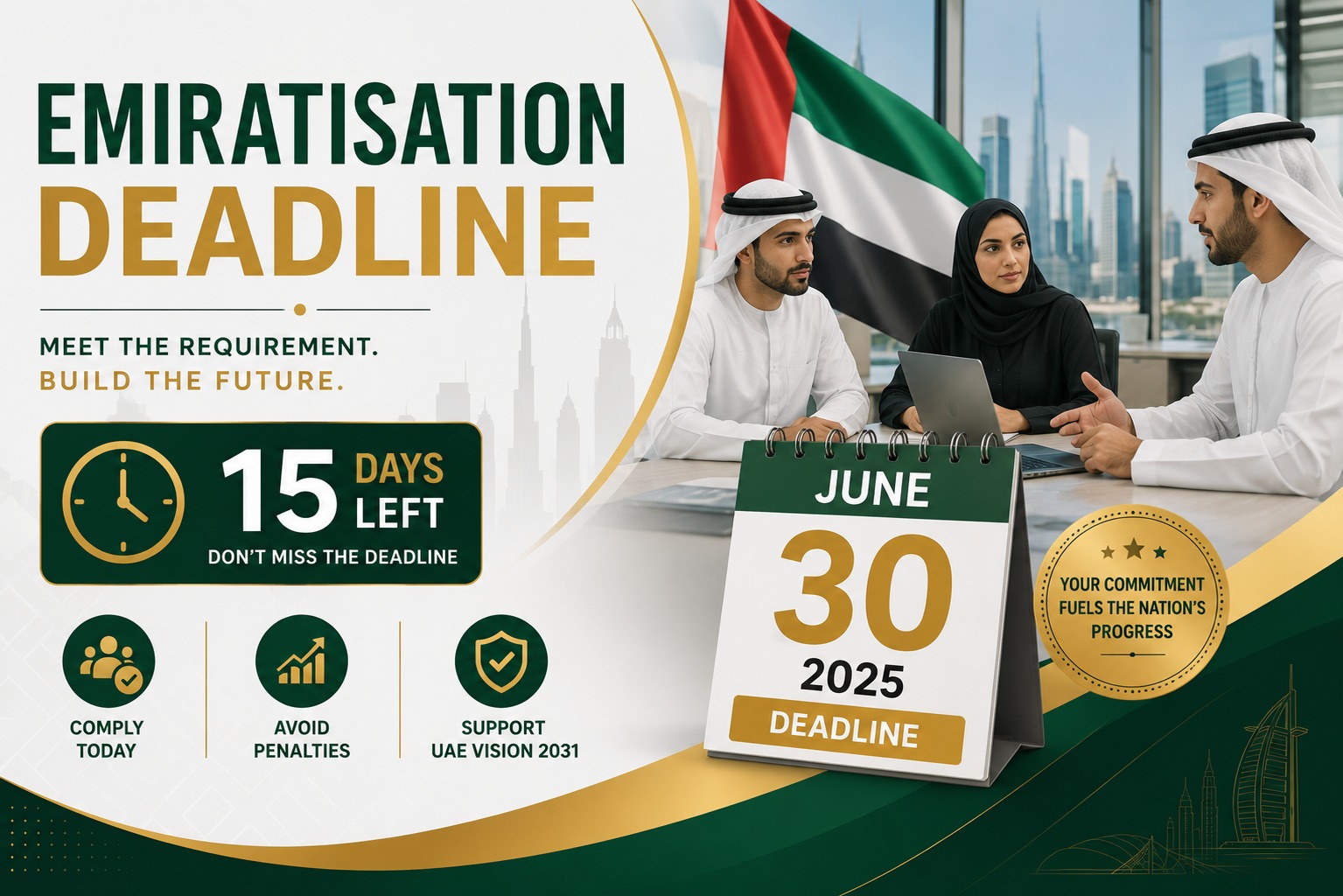
The clock is ticking for private sector employers across the UAE. By 30 June 2026, companies subject to Emiratisation rules must achieve a 1% increase in their Emirati workforce in skilled roles — or face financial penalties starting 1 July. With just weeks remaining, the Ministry of Human Resources and Emiratisation (MoHRE) has issued repeated reminders urging businesses to act now rather than wait until the final days of UAE Emiratisation Deadline June 30, 2026.
Need to calculate gratuity? Use our free calculator
This guide breaks down exactly what the deadline means, who it applies to, how much non-compliance could cost your business, and what steps you can take right now to stay compliant — or even benefit from it.
What Is Emiratisation?
Emiratisation (also spelled Emiratization) is a UAE government workforce policy designed to increase the participation of UAE nationals in private sector employment. It is a cornerstone of the country’s economic diversification strategy, aiming to build a sustainable, competitive labour market while ensuring Emirati citizens have strong access to private sector careers — not just government jobs.
The policy is governed by Cabinet Resolution No. (19/5m) of 2022 and its subsequent amendments, which set annual Emiratisation growth targets for in-scope companies.
📋 Official source: MOHRE – Cabinet Resolutions on Emiratisation
The June 30, 2026 Deadline: What’s Required
MoHRE has confirmed that 30 June 2026 is the final deadline for private sector establishments to meet their first-half 2026 Emiratisation targets. The annual target structure works as follows:
| Period | Required Increase | Deadline |
|---|---|---|
| First half of 2026 (H1) | 1% increase in skilled Emirati roles | 30 June 2026 |
| Second half of 2026 (H2) | Additional 1% (total 2% for the year) | 31 December 2026 |
Starting 1 July 2026, MoHRE will begin reviewing compliance and applying financial contributions to companies that have not met their H1 target. The Ministry has urged businesses not to wait until the last days of June, stressing that hiring, onboarding, and registration with relevant authorities all take time.
📋 Official source: Gulf Today – MoHRE June 30 Deadline Announcement
Which Companies Are Affected?
Emiratisation requirements apply differently depending on company size and sector:
| Company Size | Requirement |
|---|---|
| 50+ employees (mainland, in-scope sectors) | 1% increase in skilled Emirati roles every 6 months (2% annually) |
| 20–49 employees (14 specified economic sectors) | At least 1–2 Emirati nationals hired, per Cabinet Decision expanding scope |
| Below 20 employees | Not currently subject to mandatory Emiratisation quotas |
The 14 targeted economic sectors include information and communications, financial and insurance activities, construction, manufacturing, transportation and storage, hospitality, healthcare, education, real estate, professional and scientific services, administrative services, arts and entertainment, mining, and electricity and gas supply.
📋 Official source: UAE Government Portal – Emiratisation
What Happens If You Don’t Meet the Target?
Non-compliant companies face escalating financial contributions for every skilled position that should be filled by an Emirati national but isn’t. The penalty structure has increased year over year since the policy’s introduction in mid-2022:
| Year | Monthly Fine per Unfilled Position | Approx. Annual Cost |
|---|---|---|
| 2023 | AED 6,000/month | AED 72,000 |
| 2024 | AED 7,000/month | AED 84,000 |
| 2025 | AED 8,000/month | AED 96,000 |
| 2026 | AED 9,000/month | AED 108,000 |
⚠️ The fine increases by approximately AED 1,000 per month for every year of continued non-compliance. A company that has been non-compliant since 2023 could be paying significantly more per unfilled position in 2026 than a company that only recently fell behind.
Beyond direct fines, non-compliance also affects a company’s standing with MoHRE in other ways:
- Company classification downgrade — affecting access to labour-related services such as new work permits and visa processing
- Exclusion from the Emiratisation Partners Club — missing out on fee discounts and procurement priority
- Increased scrutiny via MoHRE’s digital field monitoring system, which is designed to detect non-compliant practices including “fake Emiratisation”
📋 Official source: Gulf News – UAE Urges Private Sector to Meet Emiratisation Targets
What Counts as “Fake Emiratisation”?
MoHRE has explicitly warned against practices designed to artificially inflate Emiratisation figures without genuine employment. Examples include:
- Hiring Emirati nationals on paper without assigning real work or paying real salaries
- Registering UAE nationals in roles they do not actually perform
- Listing employees who are simultaneously employed elsewhere on a full-time basis
- Manipulating WPS salary records to falsely show Emirati employment
The public — including employees and job seekers — can report suspected violations directly to MoHRE through its smart app or call centre. Companies found engaging in fake Emiratisation face legal action in addition to standard non-compliance penalties.
How to Meet Your Target Before June 30
1. Use the Nafis Platform
Nafis is the UAE’s federal programme connecting private sector employers with job-seeking Emirati nationals across a wide range of specialisations. Recently extended through 2040 by directive of His Highness Sheikh Mohamed bin Zayed Al Nahyan, President of the UAE, Nafis offers:
- Access to a large, pre-vetted pool of Emirati jobseekers
- Salary support and pension contributions for qualifying hires
- Training and upskilling support to prepare candidates for specific roles
- Recently expanded child allowance support and extended financial support periods for Emirati employees
📋 Official source: Nafis Platform – nafis.gov.ae
2. Register Employees Correctly with WPS and Pension Funds
MoHRE has specifically highlighted the importance of registering UAE national employees with the Wage Protection System (WPS) and an authorised pension fund (such as GPSSA). Incomplete registration can mean a hire doesn’t count toward your Emiratisation percentage, even if the person is genuinely employed.
3. Audit Your Current Emiratisation Rate
Before assuming you need to hire, check your current standing through your MoHRE company account. Some businesses are closer to their target than they realise — or may have employees who qualify but aren’t correctly registered as Emirati nationals in the system.
4. Plan for Skilled Roles, Not Just Headcount
The 1% target specifically refers to skilled jobs — defined under MoHRE’s occupational classification as skill levels 1–3 (managerial, professional, technical, and associate professional roles). Hiring Emirati nationals into unskilled roles will not count toward your target.
The Upside: The Emiratisation Partners Club
Compliance isn’t just about avoiding penalties — it comes with tangible rewards. Companies that meet their Emiratisation targets are enrolled in the Emiratisation Partners Club, which offers:
- Discounts of up to 80% on MoHRE service fees
- Priority status in government procurement processes
- Access to additional government support programmes as they are introduced
For businesses that regularly process work permits, visa applications, and labour contracts, the service fee discounts alone can represent significant operational savings — making early compliance a smart financial decision, not just a regulatory one.
What This Means for HR Teams Right Now
With the deadline only weeks away, HR and compliance teams should treat this as an immediate priority:
- Check your current Emiratisation percentage via your MoHRE account today
- Identify the gap between your current rate and the required 1% increase
- Browse Nafis for candidates matching your open skilled roles
- Fast-track onboarding — registration with WPS and pension funds must be completed, not just the offer letter signed
- Document your compliance efforts in case of an audit, especially if you are close to but not yet at target
If your company is genuinely unable to meet the target despite active efforts, MoHRE has indicated it engages constructively with companies that demonstrate ongoing recruitment activity — but documentation and a clear hiring pipeline matter.
FAQs
Does the Emiratisation requirement apply to free zone companies?
Mainland companies are the primary focus of the current targets. Some free zones have their own Emiratisation initiatives, so companies operating in free zones should check directly with their respective free zone authority as well as MoHRE.
Is the 1% increase based on headcount or percentage of total workforce?
It is a percentage-based target applied to your skilled workforce. The exact number of hires required depends on your total skilled employee count — larger companies will need to hire more Emirati nationals in absolute terms to achieve the same 1% increase.
Can part-time or contract Emirati employees count toward the target?
MoHRE’s monitoring system is designed to detect arrangements that don’t reflect genuine, substantive employment. Roles should reflect real working hours, real salaries via WPS, and real job responsibilities to count toward compliance.
What if we hire an Emirati national after June 30 — do we still get fined for H1?
Based on MoHRE’s stated approach, financial contributions apply from 1 July for the H1 shortfall. Hiring afterward helps avoid continued monthly accrual and positions the company for the H2 (year-end) target, but does not retroactively cancel H1 contributions already triggered.
Where can employees check if their employer is Emiratisation-compliant?
This information is not publicly searchable per company. However, employees who suspect fraudulent practices (such as being listed as an employee without real work) can report this through the MoHRE smart app or call centre.
Key Takeaways
- Private companies with 50+ employees must achieve a 1% increase in skilled Emirati roles by 30 June 2026
- Companies with 20–49 employees in 14 specified sectors have separate, smaller hiring requirements
- Non-compliance can cost up to AED 108,000 per unfilled position annually in 2026, with penalties starting 1 July
- The Nafis platform is the recommended channel for sourcing qualified Emirati talent
- Compliant companies join the Emiratisation Partners Club, unlocking fee discounts and procurement priority
- “Fake Emiratisation” is actively monitored and can lead to legal action
Official Government Resources
| Resource | Link |
|---|---|
| MOHRE – Cabinet Resolutions on Emiratisation | mohre.gov.ae |
| UAE Government Portal – Emiratisation | u.ae |
| Nafis Platform | nafis.gov.ae |
| MOHRE Labour Complaints / Smart App | mohre.gov.ae/complaints |
Managing HR compliance alongside employee entitlements? Make sure your gratuity and leave encashment calculations are accurate and up to date with our free UAE Gratuity Calculator and Leave Encashment Calculator — built for HR teams and employees alike.
Staying on top of other UAE digital compliance steps? See our guide on signing the UAE National Pledge online.